The Great F&B Debate: Virtual vs. Physical Dining
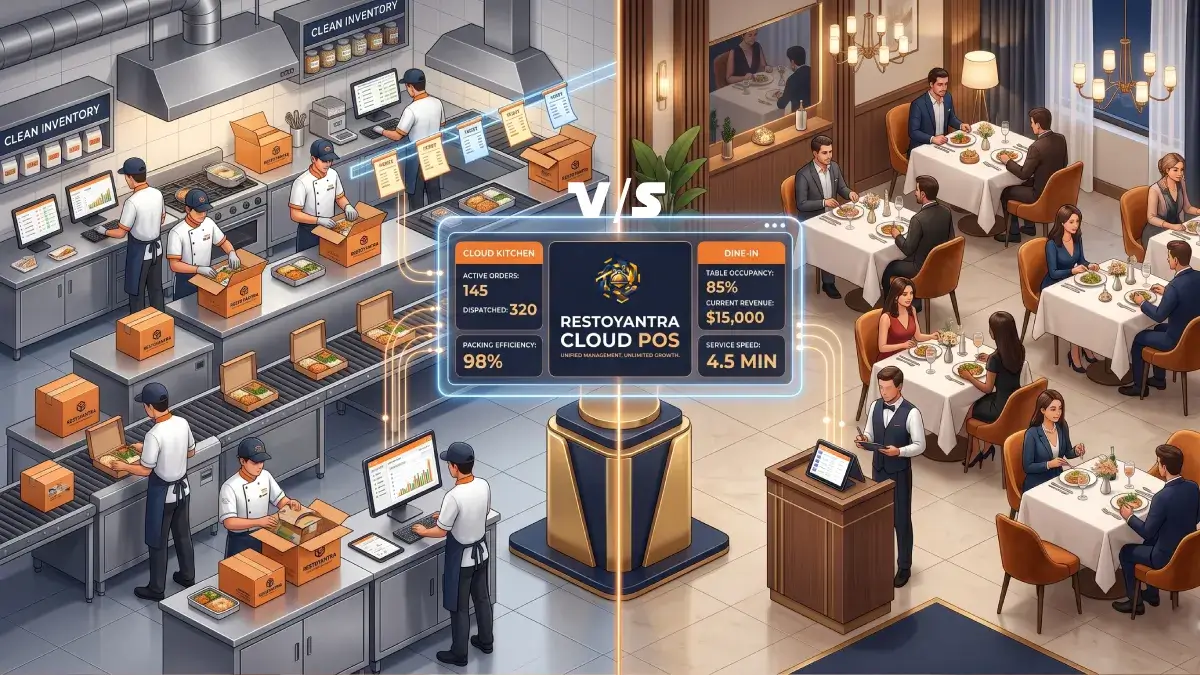
The Indian Food and Beverage industry is undergoing a structural transformation. For aspiring food entrepreneurs and veteran restaurateurs alike, the fundamental question when expanding or launching in 2026 is no longer just "what to cook," but "how to serve." The debate between launching a Cloud Kitchen (also known as a ghost or dark kitchen) versus a Traditional Dine-In Restaurant is the defining strategic choice of the decade.
Both models offer immense potential, but their financial anatomy—startup costs, operational overheads, and net profit margins—are drastically different. To determine which is more profitable in the Indian context, we must conduct a side-by-side analysis of the Capital Expenditure (CAPEX) and Operational Expenditure (OPEX) involved.
Automate Your Restaurant Today!
Stop losing money to manual errors. Join RestoYantra and manage billing, KOT, and inventory seamlessly from any device.
Startup Costs (CAPEX): The Initial Hurdle
The most immediate difference between the two models lies in the barrier to entry.
Traditional Restaurant Startup Costs
A traditional restaurant is fundamentally a real estate and hospitality business combined. Securing a prime location with high foot traffic is mandatory, leading to exorbitant rental deposits. Furthermore, you must invest heavily in interior design, customer seating, ambient lighting, and premium tableware. In a major Indian metro, launching a modest 50-seater premium cafe or restaurant can easily require a capital investment ranging from ₹30 Lakhs to ₹1 Crore, largely due to aesthetic and location-based expenses.
Cloud Kitchen Startup Costs
Cloud kitchens strip away the hospitality front-end, operating entirely on a delivery-only model. You do not need a high-street location; a functional commercial space in a secondary street or industrial area is perfect, drastically reducing rental deposits. There is zero investment in front-of-house decor, seating, or guest amenities. You only invest in high-quality commercial cooking equipment, ventilation, and a robust technology stack. A fully equipped cloud kitchen can be launched for anywhere between ₹5 Lakhs to ₹15 Lakhs.
Winner on Startup Costs: Cloud Kitchens. They offer a significantly lower barrier to entry and reduced financial risk.
Operational Overheads (OPEX) and Margins
While cloud kitchens win on initial setup, the monthly operational realities paint a more nuanced picture of profitability.
The Cost of Labor
A traditional restaurant requires a diverse staff: executive chefs, sous chefs, a front-of-house manager, waiters, hostesses, and cleaning crew. Labor costs can consume 15% to 20% of total revenue. A cloud kitchen only requires kitchen staff and a dispatcher. By eliminating front-of-house personnel, cloud kitchens keep labor costs remarkably lean.
Customer Acquisition and Commissions
This is where the traditional restaurant fights back. A well-located traditional restaurant benefits from organic footfall and visual brand presence. Their marketing cost is partially baked into their high rent.
Cloud kitchens, being virtually invisible in the physical world, rely entirely on digital discovery. They are heavily dependent on delivery aggregators like Zomato and Swiggy. These platforms typically charge commissions ranging from 18% to 28% per order. Additionally, to stand out on these apps, cloud kitchens must spend heavily on in-app advertising and discounts. These massive digital marketing and commission costs often eat into the savings generated by lower rent.
Average Order Value (AOV)
Traditional restaurants almost always boast a higher AOV. Diners are susceptible to impulse purchases—an extra appetizer, premium beverages, or desserts—driven by ambiance and waiter upselling. In a cloud kitchen model, customers are highly targeted and often order single meals, leading to a lower AOV.
Compliance and Taxation Realities
Regardless of the model, compliance is identical. Both require a valid FSSAI License to operate legally. On the taxation front, both models currently fall under the 5% GST bracket (without Input Tax Credit) for food services. Managing complex composite supply rules, such as differentiating taxes on packaging charges versus the food itself, requires meticulous accounting. You can review the latest compliance mandates on the official GST Portal.
The Verdict: Which is More Profitable?
There is no universal winner; profitability depends on your business strategy:
- Cloud kitchens are more profitable for multi-brand scalability. If you can operate 3 to 4 distinct virtual brands from a single kitchen using shared ingredients, you maximize your asset utilization and achieve volume-based profitability.
- Traditional restaurants are more profitable in terms of brand equity and net margin per order. If you successfully build a loyal dine-in customer base, you escape the crushing 25% delivery commissions, retaining a higher percentage of every rupee earned.
Unifying Your Operations with RestoYantra
Whether you choose the high-volume, multi-tenant complexity of a cloud kitchen or the experiential charm of a dine-in restaurant, your profitability hinges on operational efficiency and strict inventory control. Without the right technology, food wastage and billing errors will destroy your margins.
RestoYantra is engineered to be the ultimate growth engine for both models. For traditional restaurants, our sophisticated QR menu Ordering System">QR Menu Ordering System elevates the dine-in experience while accelerating table turnover. For cloud kitchens, our multi-tenant architecture allows you to seamlessly manage inventory and billing for several virtual brands from one unified dashboard.
With an integrated billing software India">restaurant billing software that automatically handles Indian GST logic and a powerful inventory management">inventory management module to track every gram of your raw materials, RestoYantra provides the enterprise-grade precision you need. Stop guessing your margins. Take absolute control of your F&B business and maximize your profitability with RestoYantra today.