Introduction: The Delicate Art and Science of Menu Pricing
In the vibrant and relentlessly competitive Indian Food & Beverage (F&B) landscape, your menu is more than just a list of dishes; it is your primary sales tool, your brand ambassador, and the definitive blueprint for your profitability. Yet, many restaurant owners, cafe founders, and cloud kitchen operators in India view pricing as a guessing game, often merely undercutting competitors or applying a flat, arbitrary markup. This approach is not only inefficient but also dangerous for long-term sustainability.
Setting the right price for your food requires a strategic balance. Price too high, and you risk alienating value-conscious Indian consumers. Price too low, and you leave significant money on the table, jeopardizing your ability to cover rising operational costs, rent, and labor. Mastering **restaurant menu pricing strategy** is about shifting from intuition to data-driven decision-making. This guide will provide actionable strategies tailored for the Indian market to ensure every item on your menu contributes optimally to your bottom line.
Automate Your Restaurant Today!
Stop losing money to manual errors. Join RestoYantra and manage billing, KOT, and inventory seamlessly from any device.
The Essential Foundation: Knowing Your True Costs
Before you can apply advanced pricing psychological strategies, you must have an airtight understanding of your costs. You cannot price for profit if you do not know the cost of the plate.
1. Raw Ingredient Cost (The Recipe Cost)
This is the precise cost of every single ingredient required to create a specific dish. This must include garnish, oils, spices, and even packaging for delivery orders. Many Indian operators fail because they ignore the fractional costs of spices or high-value ingredients. To manage this effectively, you need a robust system for **recipe management**. When you know that your *Paneer Butter Masala* costs exactly ₹95 to produce, you can begin to make informed decisions about its selling price.
2. Prime Cost
Prime cost is the combination of your total Cost of Goods Sold (COGS)—which is your raw ingredient cost plus beverage cost—and your total labor cost. In the Indian context, labor costs can vary significantly, but Prime Cost should ideally hover between 55% to 60% of your total revenue. Keeping this metric in check is vital for survival. Utilizing modern billing software India">restaurant billing software can help you track sales against these prime costs dynamically.
3. Gross Profit Margin
Gross Profit is the selling price minus the raw ingredient cost. Gross Profit Margin is this amount expressed as a percentage of the selling price. For example, if you sell that *Paneer Butter Masala* for ₹300, your gross profit is ₹205 (₹300 - ₹95). Your margin is 68.3% (₹205 / ₹300). Successful restaurants typically aim for an overall food gross profit margin of 65% to 75%.
Core Menu Pricing Methodologies
Once your costs are finalized, you can choose a pricing model that fits your brand concept. Here are the three most effective models for the Indian market:
1. Ideal Food Cost Percentage Method
This is the most common method. You determine your desired food cost percentage and derive the price from there. For instance, if your *Murg Makhani* costs ₹120 and your target food cost percentage is 30%:
Formula: Cost of Item / Target Food Cost % = Menu Price
₹120 / 0.30 = ₹400.
This method ensures that if you control your portions and wastage, your margins remain consistent.
2. Competition-Based Pricing
This involves analyzing what competitors in your specific segment and vicinity are charging for similar dishes. While this is crucial context, **it should never be your sole pricing method**. Your competitors may have lower rent, different labor structures, or may not even know their own costs. Use competition pricing as a benchmark to ensure your data-derived prices are within the realm of acceptability for your target market.
3. Demand-Based Pricing
Also known as dynamic pricing, this involves adjusting prices based on demand, time of day, or day of the week. While common in airlines and hotels, it is gaining traction in Indian F&B, particularly for cloud kitchens. For example, you might offer a "Lunch Thali" at a lower price on slow weekdays to boost volume, and premium pricing on weekends for signature dishes. Your POS system's analytics and reporting capabilities are crucial for identifying these high and low demand periods.
The Psychology of Menu Pricing: Subtle Triggers for Bigger Spends
Pricing is not just math; it is psychology. Indian consumers are highly attuned to value, but they are also susceptible to clever menu engineering. These subtle tactics can significantly increase your Average Order Value (AOV):
1. The Anchor Effect
Place a highly profitable, relatively expensive item at the top of a category or the main menu page. This "anchors" the perception of price. Other items below it seem more reasonably priced by comparison, even if they are still premium.
2. Eliminate Currency Symbols
Research indicates that removing the currency symbol (the ₹ sign) shifts the customer's focus away from the "pain of paying" and toward the dining experience itself. Simply listing the price as 400 rather than ₹400.00 can slightly reduce price sensitivity.
3. The Decoy Effect
This is often used in beverage sizing or high-ticket items. Offer three options. The middle option (the decoy) is priced very close to the most expensive option, but with significantly fewer benefits. This makes the most expensive option appear to have the best value, nudging customers to upspend. For instance:
- Small Coke: ₹80
- Medium Coke: ₹130 (The Decoy)
- Large Coke: ₹145 (The Upspend Target)
Most customers will see that for only ₹15 more, they get the Large.
4. Charming Prices vs. Rounded Prices
Ending prices in odd numbers like ₹199, ₹249, or ₹499 is known as charm pricing and creates the illusion of a significantly lower price (the left-digit effect). This is highly effective for QSRs and casual dining. However, for premium fine-dining establishments, rounded prices like ₹800 or ₹1200 communicate luxury and quality.
Important Compliance Tip: While applying these strategies, ensure your menu clearly states whether prices are inclusive or exclusive of mandatory taxes. For the latest updates on Goods and Services Tax (GST) compliance for restaurants, always consult the official GST Portal. Failing to do so can lead to legal issues and damage trust with your customers.
Leveraging Technology for Strategic Pricing
Implementing a sophisticated restaurant menu pricing strategy manually is cumbersome and prone to error. In today's digital age, your Point of Sale system is your most critical asset in optimizing profitability.
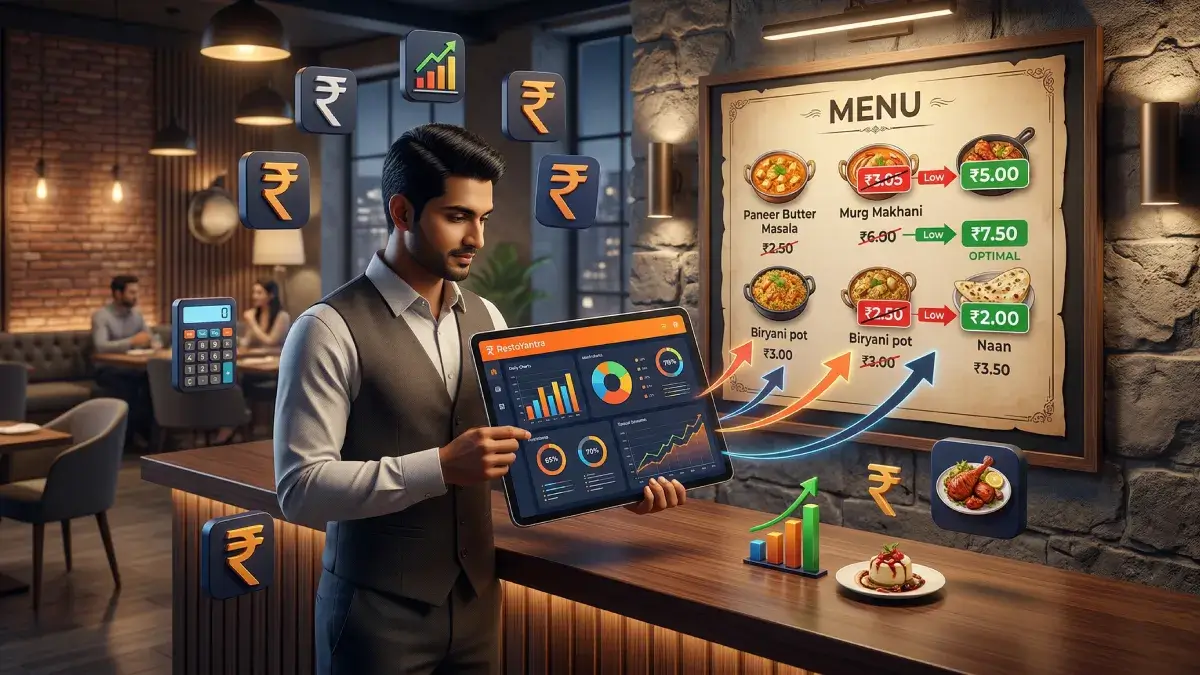
A premium Cloud POS like RestoYantra provides real-time inventory management Software">inventory management software that automatically updates your COGS based on current ingredient purchase prices. It offers robust recipe costing modules that show you your exact margin on every plate. Perhaps most importantly, its analytics dashboard can identify your "Stars" (high popularity, high profitability items) and "Plowhorses" (high popularity, low profitability), allowing you to make precise adjustments—either through slight price increases on Plowhorses or highlighting Stars through menu engineering.
Conclusion: Turn Your Menu Into a Profit Machine
Menu pricing is not a set-it-and-forget-it task. It is a dynamic process that requires continuous monitoring of ingredient costs, competitor moves, and sales data. By combining a deep understanding of your costs with psychological pricing principles and leveraging the analytics of a modern POS, you can transform your menu from a simple list into a powerful engine for profitability.
Stop guessing. Start strategizing. RestoYantra provides the premium, data-driven tools Indian restaurateurs need to manage costs, analyze performance, and execute a winning pricing strategy effortlessly. Book a demo today and take the first step toward maximum profitability.